The fitness class you wish you started sooner! Many people picture water aerobics as a…
Knee Pain (Part 2) : Common Causes
Common causes of knee pain
A vast number of tissues make up the complex knee joint. Injuries, mechanical or movement problems, overuse, or chronic conditions such as arthritis cause knee pain. Our primary concern is to determine the root cause of your knee pain so that we can address it through treatment.
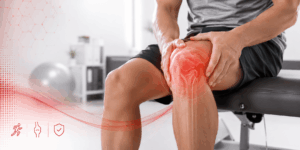
Knee injuries
Contact & non-contact
Contact or non-contact mechanisms can injure your knees. This could include bumping your knee against a table or if something falls on or against your knee. Non-contact knee injuries commonly occur when the knee buckles during landing after a jump, while rapidly changing direction, or when attempting to decelerate the body. These injuries are generally sudden with a rapid onset of pain and swelling.
Some of the common knee injuries include:
-
Ligament injury
When injuring a ligament, it is commonly referred to as a sprain. A sprain occurs when the ligament is partially torn (grade 1) or completely torn (grade 3). In some cases, more than one ligament can be torn. CLICK HERE to learn more about ligament injuries and what signs and symptoms may occur depending on the severity of the sprain
-
Torn meniscus/cartilage
The meniscus is found in between your thighbone and shinbone. It acts as a shock absorber and allows for smooth fluid motion of the bones over each other when bending or straightening your knee. Meniscus injuries generally occur when there is a sudden twisting of the knee while weight-bearing. In some cases, you may experience locking or catching in the injured knee. This may be due to cartilage that has become detached and wedged in the knee joint.
-
Fractures
Falls or hard collisions can break the bones of the knee including the kneecap. If you suffer from osteoporosis (i.e., brittle bones) a fracture can occur a lot easier.
Overuse & biomechanical related injuries
Overuse injuries arise with repetitive movements that can irritate various structures of the knee joint. The irritation causes inflammation with pain and swelling. Biomechanical-related injuries are closely related to overuse injuries. Biomechanical factors include muscle imbalances in strength, endurance, flexibility, and coordination.
-
Patellar Tendonopathy (“Jumpers knee”)
Previously known as patellar tendonitis. This injury is commonly found in activities or sports that include running and jumping. A key symptom of this injury is pain that you can pinpoint or localize. The pain will be localized to the undermost part of the knee cap. On the undermost part of the knee cap, localized pain Flare-ups in pain will occur with high and fast-load activities such as running or jumping.
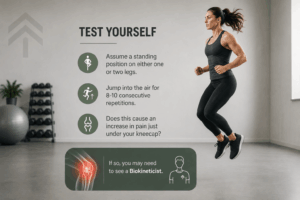
CLICK HERE to fill out our online contact form and let us know what you are struggling with.
-
Iliotibial Band Syndrome (ITB) – (“Runners’ knee)
This injury is common for runners and cyclists. You will generally feel pain on the outer or lateral part of the knee. The injury can result from the wrong alignment of the foot, lower leg or hips during exercise. Muscle imbalances can also play a major role in the progression of the injury. Together these factors may influence your movement mechanics and irritate the knee.
-
Patellofemoral Pain Syndrome (PFPS)
The injury generally results in pain around or under the knee cap. This injury occurs when the knee cap does not move correctly at the knee joint. Muscle weakness or poor movement can cause improper alignment of the knee cap. This injury can occur when there is a sudden increase in training. Pain is generally dull and achy and increases when walking up or down stairs, kneeling and/or squatting.
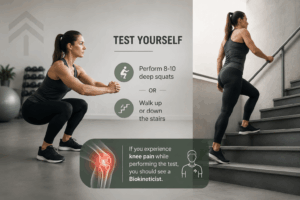
CLICK HERE to book an evaluation appointment with our Biokineticists.
Chronic knee conditions
Arthritis is a common chronic condition that negatively affects the knee. There are several different kinds of arthritis:
-
Osteoarthritis (OA)
This is the most common form of arthritis in physically active people. It occurs when the knee cartilage surface wears out over time. As a result, there is bone-to-bone contact with subsequent pain that becomes worse with movement. In addition to these symptoms, people usually experience some degree of stiffness first thing in the morning.
OA mostly occurs in weight-bearing joints, such as knees. Several factors can contribute to the development of knee OA such as gender, age, nutrition, and weight. Repetitive stress occupations can also make you more susceptible to this condition. In addition, previous knee injuries can also increase the risk for early-onset OA. Symptoms of this condition usually worsen over time.
-
Rheumatoid Arthritis (RA)
RA is an inflammatory form of arthritis and the most debilitating form of arthritis. RA is autoimmune, meaning your body’s natural defences mistakenly attack your joints. In contrast to OA, RA can occur in any joints and is not limited to weight-bearing joints. Those affected by RA tend to have joints that are always painful with prolonged morning stiffness.
CLICK HERE to see what services our Biokineticists have to offer.
Related Posts