Common mistakes and solutions Fat loss and "leaning out" are common goals that many people…
Knee Ligament Injuries
What are ligaments?
People often confuse ligaments with tendons. Put simply, ligaments attach bone to bone and tendons attach muscles to bone. Ligaments are thick bands of tightly packed bundles of connective tissue mostly made up of collagen. Most importantly, your ligaments are the main providers of stability and strength to your joints. Think of ligaments as ropes compacted together in parallel. Whilst ligaments have some elastic fibres to allow movement at joints, they can be overstretched or even torn. This is commonly known as a sprain. While the knee is built to withstand a lot, it has areas of weakness. That is to say, the knee has a much lower tolerance for shear and rotational loads.
You are unique and deserve an individualized treatment plan. CLICK HERE to fill out the online contact form and we will get back to you.
Ligaments of the knee
Knees receive their primary support from 4 ligaments that are found both inside and outside the joint. We can think of our ligaments as seat belts for our joints as they function to prevent excessive movement. There are two key internal ligaments called the anterior cruciate ligament (ACL) and posterior cruciate ligament (PCL). These ligaments cross each other in the knee to form an “X”. Two Outer ligaments include the medial collateral ligament (MCL) and lateral collateral ligament (LCL) which can be found on the inner and outer sides of the knee respectively.
How are knee ligaments injured?
Not only are knee ligaments injured in sports. They can be injured in daily activities too. For example, getting out of a car, going up or down stairs. Injuries are categorized as contact- or non-contact sprains. Non-contact knee injuries include: falling from a height, sudden change of direction or deceleration (side step) and twisting at the knee while the foot is firmly planted on the floor. Contact injuries occur with force, such as being tackled or if an object falls on the knee.
Ligaments often sprained include those at the ankle, knee, and wrist. Signs and symptoms of injured knee ligaments differ depending on how severe the sprain is. Therefore, ligament sprains are categorized into 3 grades.
Do you have any of the signs and symptoms listed below for a grade 1, 2, and 3 ligament injury? CLICK HERE to schedule an appointment with a Biokineticist.
Did You Know?
Women face a greater risk of sprains than men. This is the result of several factors including leg angles (due to a wider pelvis), hormone levels, ligament sizes and structure, muscle strength and control deficits.
Which healthcare professionals can assist with a knee injury?
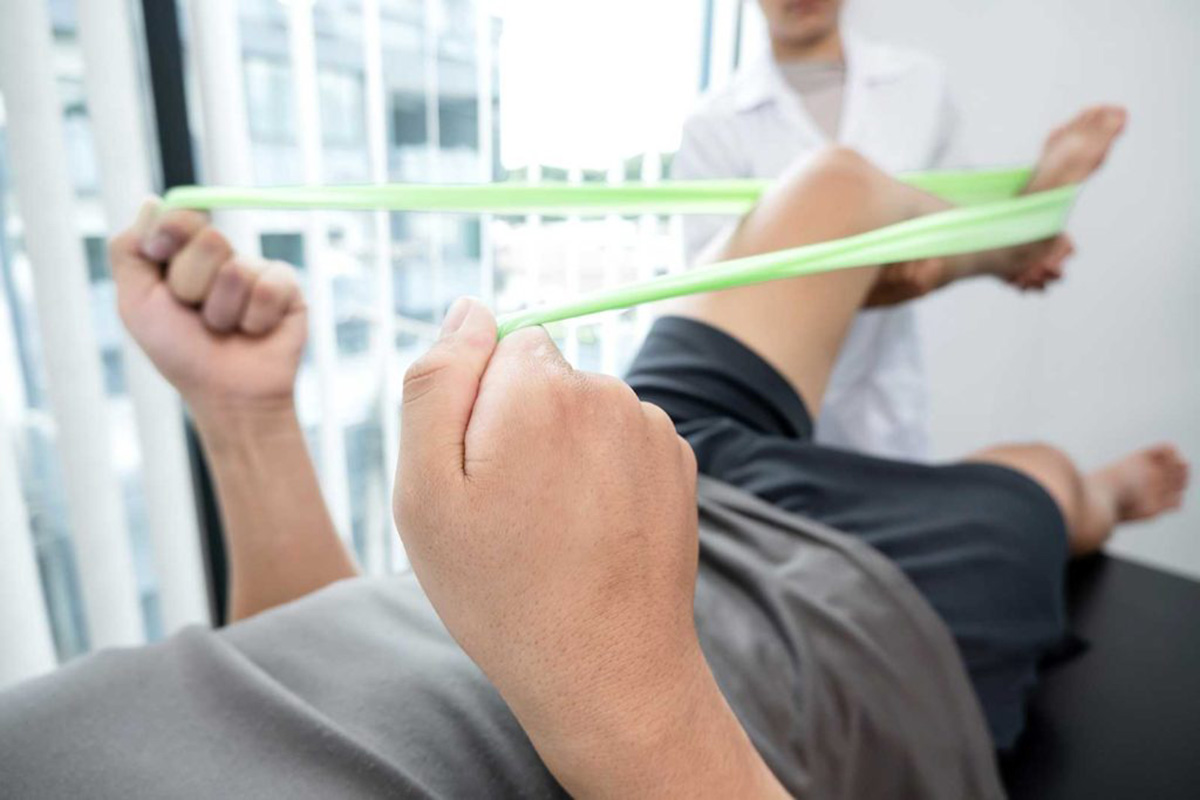
See below how both a Biokineticist and Physiotherapist play critical roles in treating any knee ligament injuries. You must see a healthcare professional for a holistic treatment approach to get your knee back to full function and reduce your risk of re-injury.
CLICK HERE to see what Biokinetics services we provide
Grade of ligament injury
Grade 1
- Some stretching of the ligament
- Minimal instability
- No major problem with function (Can still move knee through a full range of motion)
- Mild pain with fully straightened or bent knee
- Little to no swelling
Grade 2
- Slight tearing/stretching of ligament fibres
- Knee feels unstable
- Immediate bruising and swelling around the knee
- Knee stiffness
- Mild to severe pain which is worse when putting weight on leg
- May have an unwillingness to move leg or put weight on it
Grade 3
- Complete tear of the ligament into two parts
- When the injury occurs, an audible pop may be heard
- Knee feels very unstable
- Initially, severe pain may be followed by little to no pain
- Severe swelling (usually within 24 hours)
- Joint becomes very stiff a few hours after (usually within 24 hours)
- Painful to put weight on the leg
- Initial unwillingness to move the knee
- Leg feels as if it gives way or buckles
Related Posts