The fitness class you wish you started sooner! Many people picture water aerobics as a…
The Shoulder “Complex-ity”
The shoulder is one of the most remarkable joints in the human body — and also one of the most complex to rehabilitate after injury or pain develops. Unlike joints designed primarily for stability, such as the hip, the shoulder prioritizes mobility. This allows us to reach overhead, throw, lift, rotate, push, pull, and perform highly precise movements. However, this extraordinary freedom of movement comes at a cost: reduced stability and a far greater dependence on muscular coordination and positional control.
Anatomy “Claustrophobia”
The “shoulder joint” is actually more complex than we think. When most think of the shoulder joint we just look at the Glenohumeral joint, the connection between the upper arm and the shoulder blade. In reality the shoulder complex is made up of 4 joints namely:
- Glenohumeral joint – connection between the humerus (upper arm) and shoulder blade
- Acromioclavicular joint – connection between the shoulder blade and collar bone
- Sternoclavicular joint – connection between the breast bone and collar bone
- Scapulothoracic joint – where the shoulder blade moves on the rib cage

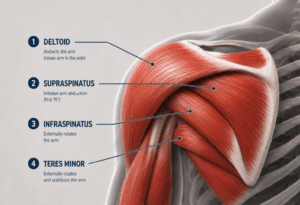
There is an important interaction between all these joints. As a result, limitations in one joint can cause compensatory or excessive movement elsewhere which can be problematic. Another major reason shoulder rehabilitation is so complex is the sheer number of structures packed into a relatively small anatomical space. We sometimes refer to this as ‘Anatomy claustrophobia’. There are 17 muscle attachments to the scapula (Shoulder blade) alone.
The rotator cuff muscles, bursae, tendons, labrum (Cartilage), ligaments, nerves, and blood vessels all coexist in close proximity. Small changes in movement mechanics or tissue irritation can quickly affect neighbouring structures. A minor loss of space or altered movement pattern may contribute to tendon compression, inflammation, reduced muscular activation, or nerve sensitivity.
At the center of this challenge is the glenohumeral joint, where the head of the humerus sits against the relatively shallow socket of the scapula. Compared to the deep, stable socket of the hip, the shoulder socket provides minimal bony restraint. Instead, the shoulder relies heavily on soft tissues such as muscles, tendons, ligaments, fascia, and the joint capsule to maintain alignment and control during movement.
This creates a delicate balancing act. The shoulder must remain stable enough to generate force and protect surrounding tissues, while simultaneously remaining mobile enough to allow an enormous range of motion. Successful rehabilitation requires thorough knowledge of these principles and how to develop and implement a structured treatment plan. Treatment needs to focus on both stability and mobility to increase the chances of success.
Rotator Cuff
I am pretty sure you have heard a friend, family member or colleague previously mentioned that they have injured their “rotator cuff muscle” or know of someone that has sustained this type of injury. The rotator cuff muscles are the most commonly injured structures at the shoulder joint.
The rotator cuff is a group of 4 small muscles which are found on the front and back of the shoulder blade. They play the crucial function of ensuring the humerus (Upper arm bone) stays centered in the shoulder socket. If one muscle underperforms or fatigues, other muscles attempt to compensate. Over time, this compensation may negatively affect joint mechanics and increase stress on surrounding tissues. Therefore rehabilitation involves far more than strengthening isolated muscle groups. It requires restoring coordinated movement patterns across the entire shoulder complex.
Regional Interdependence
Perhaps the most overlooked aspect of shoulder rehabilitation is its dependence on surrounding regions of the body. The shoulder does not function independently. It is deeply interconnected with the scapula, thoracic spine (Mid-upper back), rib cage, and cervical spine (Neck). In some cases, the primary driver of shoulder symptoms is not the shoulder itself but dysfunction elsewhere in the kinetic chain.
Scapula (Shoulder Blade)
The scapula acts as the foundation of shoulder movement. If the scapula is not positioned properly or does not move adequately, the shoulder joint itself cannot function efficiently. Think of a seal balancing a ball on its nose. If the seal does not coordinate the movement of its nose (Shoulder blade) properly, the ball (Humeral head) will fall off. Even subtle changes in scapular positioning can reduce or alter muscular activation patterns and increase strain on tendons or ligaments.
Thoracic spine (Mid-Upper Back)
Similarly, thoracic spine mobility plays a major role in shoulder mechanics. A very flat or excessively rounded thoracic spine changes the resting position of the scapula and limits the ability to effectively move our shoulder blade which can lead to problems especially when moving your arms overhead. This is particularly important in overhead sports such as cricket, javelin, tennis, and baseball which require good shoulder movement to be successful. In the general person this is also key to perform various activities of daily living such as placing or fetching an object from the top shelf. Many people attempt to compensate for poor thoracic mobility by excessively moving the shoulder joint itself or even the lower back, which can overload tissues already under stress.

Cervical Spine (Neck)
The cervical spine also contributes significantly to the overall function of the shoulder complex. Numerous muscles that attach on the neck also attach on the shoulder blade. As a result, poor positioning of the neck and head can negatively impact the movement of the shoulder blade and subsequently the shoulder joint (Glenohumeral joint).
Shoulder Complex Rehabilitation and Training
This interdependence is what makes shoulder rehabilitation particularly challenging. If one structure is not functioning optimally, it negatively affects the others. The body then develops compensatory movement strategies, often reinforcing dysfunction over time.
As a result, successful shoulder rehabilitation requires a comprehensive approach rather than a purely local one. Treating only the painful tissue is rarely sufficient. Effective rehabilitation must address mobility, stability, posture, motor control, breathing mechanics, strength, endurance, and movement coordination across multiple regions of the body.
Ultimately, the shoulder’s complexity is a reflection of its incredible capability. Few joints in the body can match its versatility and freedom of movement. Yet that same freedom requires a sophisticated system of dynamic stability and interregional cooperation. Rehabilitation is challenging not because the shoulder is poorly designed, but because it is designed for mobility first — and mobility always demands control.
At Gino Biokineticists, we understand the functional anatomy of the shoulder complex. We use this knowledge hand in hand with each patient’s history to guide our patient focused evaluation. As a result, it allows us to develop a specific rehabilitation programme that is unique to every patient. In addition, we also focus greatly on corrective shoulder training in most of our programmes to ensure better shoulder complex movement and to reduce the risk of potential injury. Prevention is better than cure!
Common injuries at the Shoulder Complex
At Gino Alho Biokineticist, we see a broad variety of shoulder injuries or patients that have recently undergone procedures to repair specific structures.
- Labral tears (Bankart lesion, SLAP lesion)
- Rotator cuff tears
- Shoulder dislocation and instability
- Bicep injuries
- Frozen shoulder
If you are an athlete or just the average Joe struggling with a shoulder injury, don’t ignore the problem or simply learn to live with the pain. Early assessment and the right rehabilitation programme can restore movement, reduce pain, improve function, and help prevent long-term complications. Whether your goal is returning to sport, getting back to work, or simply reaching the top shelf without discomfort, our team is here to guide you every step of the way.
Related Posts