Common mistakes and solutions Fat loss and "leaning out" are common goals that many people…
Knee Ligament Injuries
What Are Ligaments?
People often confuse ligaments with tendons. Put simply, ligaments connect bone to bone, while tendons connect muscle to bone.
Ligaments are thick bands of connective tissue made primarily of collagen. Their main role is to provide stability and strength to your joints. Think of ligaments as strong ropes made up of tightly packed fibres running parallel to one another.
Although ligaments contain a small amount of elastic tissue to allow normal joint movement, they can become overstretched or torn. This type of injury is known as a ligament sprain.
While the knee is designed to withstand significant forces, it has areas of weakness. In particular, the knee has a much lower tolerance for shear and rotational forces, making it vulnerable to ligament injuries.
You are unique and deserve an individualized treatment plan. CLICK HERE to complete our online contact form, and we will get back to you.
Ligaments of the Knee
The knee receives its primary stability from four major ligaments, located both inside and outside the joint.
A simple way to think of these ligaments is as the seat belts of the knee, preventing excessive movement and helping to protect the joint.
The two ligaments inside the knee are:
- Anterior Cruciate Ligament (ACL)
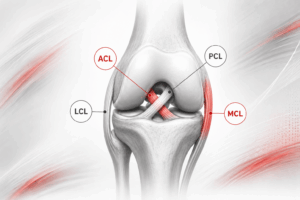
- Posterior Cruciate Ligament (PCL)
These ligaments cross each other to form an “X” within the centre of the knee.
The two ligaments on the outside of the joint are:
- Medial Collateral Ligament (MCL) – located on the inner side of the knee.
- Lateral Collateral Ligament (LCL) – located on the outer side of the knee.
How Are Knee Ligaments Injured?
Knee ligament injuries are not limited to sports. They can also occur during everyday activities, such as getting out of a car, walking up or down stairs, or slipping while walking.
Ligament injuries are generally classified as either contact or non-contact sprains.
Non-contact injuries commonly occur when:
- Falling from a height.
- Suddenly changing direction or rapidly decelerating (such as during a side-step).
- Twisting the knee while the foot remains firmly planted on the ground.
Contact injuries occur when an external force is applied to the knee, such as:
- Being tackled during sport.
- Falling onto the knee.
- Having an object strike or fall onto the knee.
Ligament sprains commonly affect the ankle, knee, and wrist. The signs and symptoms of a knee ligament injury depend on the severity of the damage. For this reason, ligament sprains are classified into three grades.
Do you have any of the signs and symptoms listed below for a Grade 1, Grade 2, or Grade 3 ligament injury?
CLICK HERE to schedule an appointment with a Biokineticist.
Which Healthcare Professionals Can Help With a Knee Ligament Injury?
Both Biokineticists and Physiotherapists play essential roles in the assessment, treatment, and rehabilitation of knee ligament injuries.
Working with both healthcare professionals ensures a comprehensive rehabilitation programme that restores knee function, improves strength and stability, and reduces the risk of future injuries.
CLICK HERE to learn more about the Biokinetics services we provide.
Grades of Knee Ligament Injuries
Mild Sprain – Grade 1
- Mild stretching of the ligament.
- Minimal joint instability.
- Little to no loss of knee function (the knee can usually move through its full range of motion).
- Mild pain when fully bending or straightening the knee.
- Little to no swelling.
Moderate Sprain – Grade 2
- Partial tearing or significant stretching of the ligament fibres.
- The knee feels unstable.
- Swelling and bruising develop soon after the injury.
- Knee stiffness.
- Mild to severe pain, especially when putting weight on the leg.
- Reluctance or difficulty bearing weight or moving the leg.
Severe Sprain – Grade 3
- Complete tear of the ligament.
- An audible “pop” may be heard at the time of injury.
- The knee feels very unstable.
- Severe pain immediately after the injury, which may later decrease significantly.
- Severe swelling, usually developing within 24 hours.
- Significant stiffness develops within a few hours (typically within 24 hours).
- Pain when bearing weight.
- Initial inability or unwillingness to move the knee.
- The knee may feel as though it gives way or buckles.
Related Posts